Garmin sold over 15 million devices last year. Their watches sit on the wrists of recreational runners, weekend warriors, and first-time marathon trainees the world over. They record pace, distance, heart rate, sleep score, body battery, HRV, calories, and dozens of other data points, session by session, day by day, building a dataset that is, in many cases, richer than anything a performance coach would have had access to a decade ago.
And almost none of it is being used to prevent the most common problem recreational runners face.
Up to 85% of recreational runners get injured every year (Kluitenberg et al., 2015). The data to flag the majority of those injuries in advance is already sitting on their wrists. The gap is not in the hardware. It is in the intelligence layer that sits between the data and the decision.
That is the gap LODE is built to close.
What Garmin does, and what it doesn't
Garmin is exceptional at what it does. The sensors are accurate. The ecosystem is mature. The data is comprehensive. Garmin's own research arm has produced some of the most significant load monitoring studies in recreational sport, including the RUNSAFE dataset (Nielsen et al., 2025), which drew on over 140,000 running sessions to find that sessions just 10% above a runner's recent load were associated with a 64% elevated injury hazard.
Garmin's native coaching features have evolved significantly, their adaptive Garmin Coach plans now adjust daily based on training load, recovery, and fitness metrics, and Daily Suggested Workouts offer flexible, real-time recommendations. But the orientation is performance and progression: faster, further, more. For a runner just starting out, that can mean being told to run 8km in week one, technically "adaptive," but not necessarily appropriate for where that runner's body actually is.
The system is not designed around injury prevention, does not apply EWMA methodology to classify injury risk zones, and has no mechanism for the practitioner, the physio or coach who needs visibility into a patient's load trend between appointments.
LODE is built for a different runner and a different goal: the recreational runner who needs a plan calibrated to where they actually are, not where the algorithm assumes they should be heading next, and practitioners who need a window into that data that doesn't currently exist.
The methodology that changes this
The sports science community has spent the better part of a decade developing and validating a more sophisticated approach to load monitoring than simple weekly mileage targets or fixed training ratios.
Exponentially Weighted Moving Average (EWMA) methodology, validated by Williams et al. (2017, BJSM) and further refined by Impellizzeri et al. (2020, BJSM) calculates both acute load (the stress of recent training) and chronic load (the accumulated fitness base) simultaneously, weighting recent sessions more heavily than older ones. The relationship between the two, and critically the direction and rate at which that relationship is changing, gives a far more accurate picture of where a runner sits on the spectrum between underprepared and overloaded than any rolling average or fixed weekly target.
This is the methodology that elite performance teams have been applying for years. It is the reason professional athletes have sports scientists monitoring their load data in real time, flagging trends before they become injuries, and adjusting training accordingly.
The recreational runner has the same data. They have never had the same methodology applied to it.
What LODE adds to the Garmin ecosystem
LODE connects directly to Garmin's data infrastructure and applies EWMA to calculate each runner's acute and chronic load from their actual training history. Not a template. Not an average. Their real numbers, updated after every session.
From that calculation, LODE classifies each runner's current training phase, recovering, maintaining, building, or overreaching, and builds a personalized weekly plan designed to keep them progressing without pushing into the injury risk zone that the research identifies. If the runner misses a session, runs harder than planned, or has a week that looks different from what was prescribed, the plan recalculates. It responds to what actually happened, not what was intended.
LODE also combines the external load data Garmin captures, distance, pace, duration, with internal load, using heart rate data to measure the true physiological cost of each run. The same 10km at the same pace means something different depending on how hard the body worked to complete it. LODE knows this. A generic training plan doesn't.
For the runner, the output is clear and actionable. Not a dashboard of metrics to interpret. Not a training log to analyse. A personalized plan, updated continuously, that tells them what their body can actually handle next, and flags when they are approaching a zone that the data suggests is risky.
The partnership opportunity in this framing
For investors and B2B partners, the Garmin framing matters beyond the product description.
Garmin has the hardware distribution. They have the data infrastructure. They have the research credibility, their own RUNSAFE study is among the most significant load monitoring datasets ever produced in recreational sport. What they do not have, and have not prioritized building, is a consumer-facing product that translates that research into personalized, adaptive guidance for the 50 million recreational runners wearing their devices.
LODE is that product. It is not competing with Garmin. It is completing the value chain that Garmin's hardware creates but does not close. The device captures the data. LODE makes it actionable.
That positioning, intelligence layer on top of established hardware infrastructure, is a model the health tech space has seen work before. The wearable collects. The platform interprets. The user benefits. The hardware partner benefits from a stickier, more valuable ecosystem.
The same logic applies to any wearable platform with rich training data and a recreational athlete user base. Garmin is the starting point. The architecture is built to extend.
Why this moment is the right one
The consumer health tech market is at an inflection point that makes this opportunity particularly well-timed.
Wearable penetration among recreational athletes has reached a level where the data infrastructure for personalised load monitoring already exists at scale. The sports science methodology is validated and peer-reviewed. Consumer awareness of the connection between training load and injury risk is growing, partly driven by Garmin's own research and communications around RUNSAFE.
What has not existed, until now, is a product built specifically for the recreational runner that sits between the data these devices produce and the behavioural change that prevents injury. Not a coaching app. Not a training plan generator. A load intelligence platform that knows who the runner is, where they are in their training cycle, and what the data says they should do next.
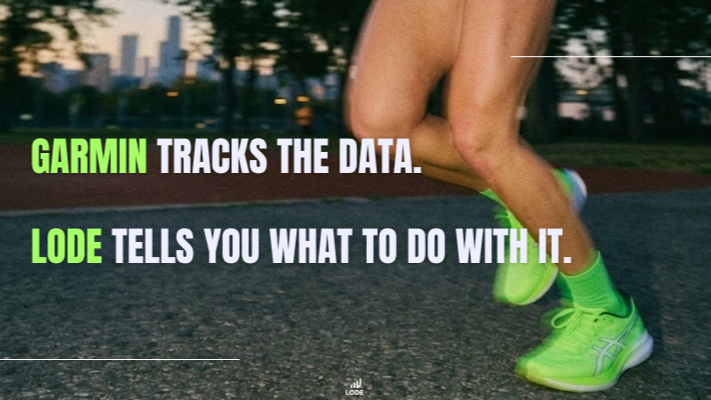
Garmin tracks the data. For the first time, recreational runners have something that tells them what to do with it.
LODE is a training load management and injury prevention app for recreational runners, built on peer-reviewed sports science. Learn more at lodefitness.com.
References: Kluitenberg et al. (2015); Kluitenberg et al. (2022); Kakouris et al. (2021); Williams et al. (2017, BJSM); Impellizzeri et al. (2020, BJSM); Nielsen et al. (2025, Garmin RUNSAFE).